





If you’ve ever found yourself at the airport, wondering whether your power bank will pass through security, then this blog is just for you. With more and more devices to keep charged, traveling with power banks has become a necessity, but the rules can be confusing.
You might be asking yourself, "Can I bring this power bank on a plane? Will I get through security without an issue?" These are common concerns for frequent travelers. In this guide, we'll simplify the TSA and airline rules to ensure your next trip goes smoothly. So you’ll know exactly what’s allowed and what’s not when it comes to bringing your power bank onboard.
And introduce you to the most reliable airline-safe power bank in the market "VoltaGo Max"
✈️ The Maximum Legal Limit for Air Travel.
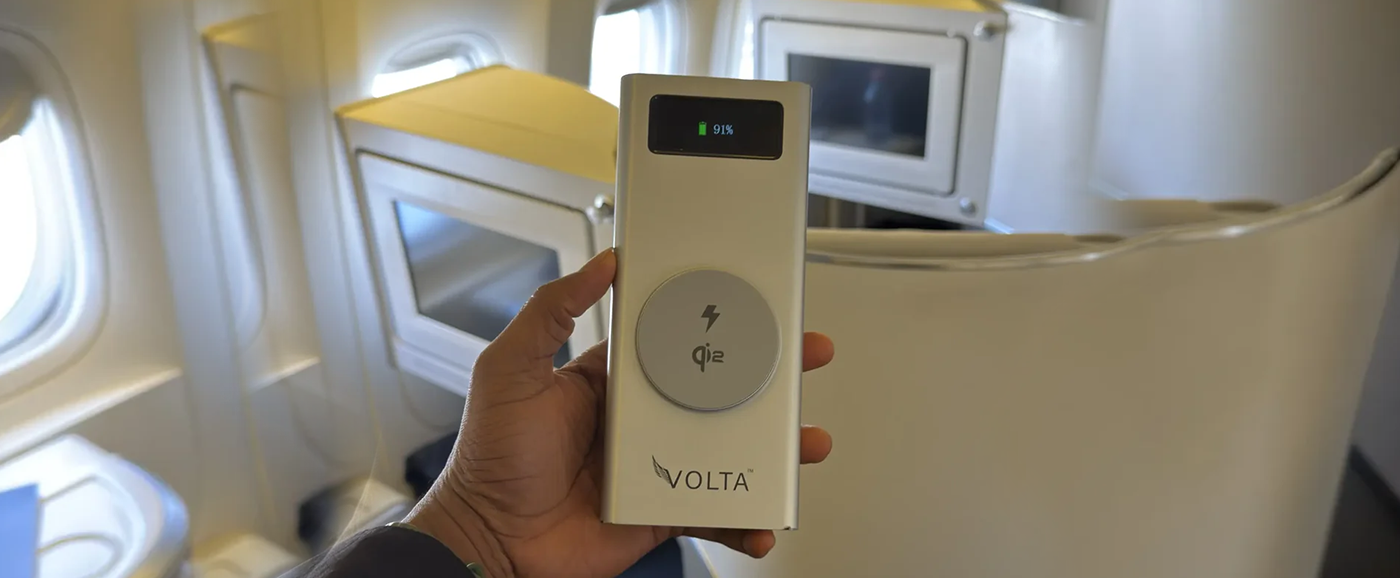
The VoltaGo MAX (27,000 mAh / 99.9Wh) flies right under the strict 100Wh TSA limit. It is the most powerful battery you can legally take through airport security.

VoltaGo MAX - 27,000 mAh
$187.00 $294.00
Save $107.0027,000 mAh Airline-Safe Portable Power Bank VOLTAGO Max is a singular power system that will work with just about any device you own. Made to ...
Airline-Approved Power Banks Compared (100Wh TSA Limit)
|
Mastering Airport Security: The Essential Power Bank Flight Blueprint
Choosing a hardware winner like the VoltaGo MAX solves the capacity problem, but you still need to know how to navigate the actual airport security lanes. To prevent sudden confiscations or delays at the conveyor belts, make sure you strictly follow this step-by-step flight breakdown:
1. TSA Regulations on Power Banks
The Transportation Security Administration (TSA) has strict guidelines for carrying power banks on planes. The key factor that determines if your power bank is allowed on board is its watt-hour (Wh) rating.
- Power banks with less than 100Wh are generally allowed in your carry-on baggage without any special permissions.
- If your power bank has a capacity between 100Wh and 160Wh, you are allowed to bring it on board, but airlines may require prior approval, and there may be a limit to how many you can carry.
- Power banks above 160Wh are prohibited from being brought on board at all, in either checked or carry-on luggage.
How to calculate watt-hours (Wh): Most power banks list their capacity in milliamp-hours (mAh). To convert this to watt-hours, use the formula:
[ Wh = (mAh × Voltage) ÷ 1000 ]
For example, the VoltaGo MAX Airline-safe Power Bank has a capacity of 27,000mAh at 3.7V, which equals about 99Wh. well within TSA’s guidelines for safe air travel.
2. Where Should You Pack Your Power Bank?
TSA rules state that power banks must be packed in your carry-on luggage and are not allowed in checked baggage. This is because power banks contain lithium-ion batteries, which can pose fire hazards if stored in the cargo hold. By keeping them in the cabin, airline staff can more easily address any safety issues.

Tip: Always double-check that your power bank is in your carry-on before heading to the airport to avoid unnecessary delays at security.
3. Exact Capacity Limits: 10,000mAh vs. 20,000mAh vs. 50,000mAh
A common mistake travelers make is searching for airline rules using milliamp-hours (mAh), while airport security measures everything in Watt-hours (Wh). Let’s break down exactly what clears the security gates:
- Can I bring a 10,000mAh power bank on a plane? Yes, absolutely. A standard 10k pack sits around 37Wh, well below the safety limit.
- Can I bring a 20,000mAh power bank on a plane? Yes. These sit at roughly 74Wh and pass checkpoint security worldwide without needing any extra airline approval.
- Can I bring a 50,000mAh power bank on a plane? Absolutely not. A 50k pack scales past 185Wh, rendering it an aviation hazard that will be confiscated immediately at security.
- The Sweet Spot: The VoltaGo MAX packs 27,000mAH (99.9Wh). It is mathematically engineered to sit exactly at the legal border, giving you the largest possible battery you can legally take onto a commercial flight.
4. Specific Airline Nuances: Ryanair, British Airways, and EasyJet Limits
Never assume every airline operates under identical conditions. Several international carriers have implemented strict operational limits on personal electronics:
- The 15-Device Cap: Major European and UK carriers like Ryanair, British Airways, and EasyJet enforce a maximum allowance of 15 personal electronic devices (laptops, phones, cameras, power banks combined) per passenger cabin space.
- The Power Bank Quantity Rule: On airlines like Ryanair and British Airways, you can carry up to 20 spare batteries in total, but only 2 of those can be dedicated power banks.
5. Post-Security In-Flight Prohibitions (The Cabin Rules)
Clearing the TSA terminal conveyor belt does not mean the restrictions are over. Once you step foot on board the aircraft, strict aviation protocols apply to your battery usage:
- No Charging the Charger: You are completely prohibited from recharging your power bank using the aircraft's built-in-AC wall plugs or seat-back USB ports.
- No Overhead Locker Storage During Use: If you use your power bank to charge your smartphone mid-flight, it cannot be left inside an overhead luggage bin. It must remain inside your seat pocket or under the seat in front of you where it can be constantly monitored for sudden thermal spikes.
- Emergency Enclosure Fitting: Airlines like Virgin Atlantic mandate that your power bank must easily fit inside their specialized onboard Fire Containment Bags in the event of an emergency. Chunky, vertical monolith power blocks struggle here, whereas the layout of the VoltaGo Max is intentionally optimized for flat travel packing.
6. Terminal Protection Protocols (Short-Circuit Prevention)
Airlines don't just care about the internal capacity of your batteries; they care about how you pack them. If your power bank rubs against keys, loose change, or metal laptop zippers inside a backpack, it can experience an accidental short circuit.
To legally protect your terminals, security protocols mandate that you do one of the following:
- Keep the battery stored inside its original retail box or a dedicated travel pouch.
- Place a thin strip of electrical tape over the exposed open USB-C ports to insulate the terminals.
7. TSA Confiscation Red Flags: Why Safe Batteries Get Rejected
Even if your battery pack sits perfectly under the 100Wh ceiling, airport security agents can still seize it on the spot if it meets any of these visual criteria:
The Unreadable Label Trap: If the capacity details (the WH or mAh values) printed on your power bank have faded, rubbed off, or become unreadable due to heavy scuffing, security agents cannot legally verify its specs. If they can't read it, they trash it.
Uncertified Hardware: Battery packs that fail to display explicit regulatory markings (like CE, FCC, or UL compliance stamps) are immediately flagged as unverified safety hazards.
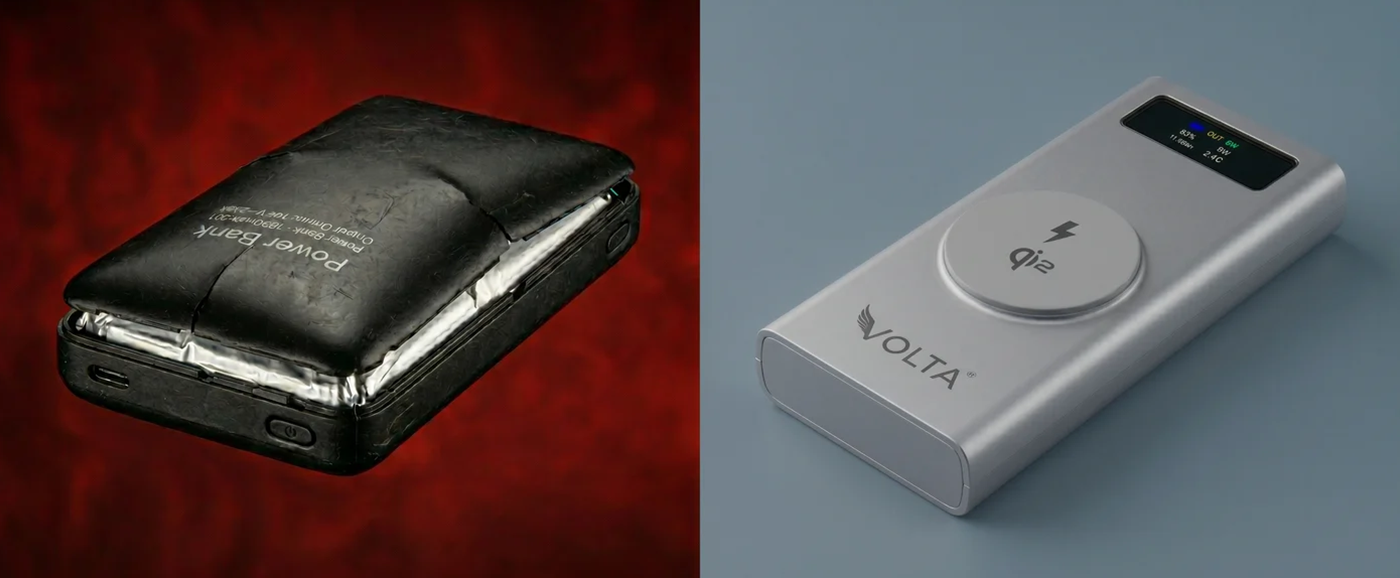
Physical Damage: Any sign of outer plastic structural cracking or internal battery expansion (swelling) will cause your battery to be instantly confiscated at the checkpoint bin.
8. Additional Safety Tips for Flying with Power Banks
To ensure smooth travels with your power bank, follow these best practices:

- Turn off the power bank while in transit, especially during takeoff and landing.
- Avoid using the power bank when your flight is taxiing or during turbulence, as this can add unnecessary strain to the device.
- Use protective covers to avoid accidental damage or power bank activation in your bag.
- Consider removable cables: Power banks with built-in cables can sometimes trigger alarms during screening.
Conclusion
Flying with a power bank doesn’t have to be complicated, as long as you follow the TSA’s watt-hour rules and check with your airline ahead of time. Keeping your power bank in your carry-on is a must, and having a device like the VoltaGo Max Airline-Safe Power Bank, which comfortably meets all the safety requirements, ensures you’ll stay charged without any extra hassle at security.

By following these guidelines, you'll be prepared for your next flight, whether you're traveling domestically or internationally.
Frequently Asked Questions: Airline Power Bank Rules
Can I bring a 20,000mAh or 30,000mAh power bank on a plane?
- 20,000mAh: Yes, absolutely. A standard 20,000mAh power bank operates at 3.7V, which equals roughly 74Wh. This is well under the global 100Wh limit and is allowed by the TSA and international airlines in your carry-on bag.
- 30,000mAh: This is a grey area. A 30,000mAh battery calculates to roughly 111Wh. Because it crosses 100Wh threshold, it technically requires prior airline approval before you board, and some strict airlines will confiscate it at the gate.
Why did security confiscate my power bank if it’s under the legal limit?
This is the number one complaint on Reddit travel threads. Even if your power bank is legally compliant, airport security (especially in Europe and Asia) will confiscate it instantly if the capacity label is faded, scratched off, or missing. If a TSA agent cannot clearly read the "Wh" or "mAh" printed on the physical chassis, they are legally required to treat it as a hazard and throw it away.
Can I actually use my power bank to charge my phone during the flight?
Airline rules have become much stricter. Major carriers (including the Lufthansa Group and several Asian airlines) completely ban the use or charging of portable batteries while mid-flight to prevent cabin fires. Other airlines, like American Airlines, allow you to use them but strictly require the power bank to remain visible on your person or in the seatback pocket, you are legally prohibited from charging a device inside an overhead bin or buried deep inside a backpack.
What happens if I accidentally leave my power bank in my checked luggage?
Do not do this. Luggage goes through heavy X-ray scanning after you check it in. If security detects a lithium-ion battery in the cargo hold, they will cut or break open your suitcase, confiscate the battery, leave a warning leaflet inside, and your bag may miss the flight entirely. Lithium batteries are a fire hazard; if they overheat in the cabin, the crew can extinguish them. If they catch fire in the cargo hold, it is a catastrophe.
How many power banks can I legally bring on a flight?
For power banks under 100Wh (like a 10,000mAh or 27,000mAh brick), the TSA allows a "reasonable quantity" for personal use, usually capped at a maximum of 20 spare batteries total per passenger (this includes your camera and laptop batteries). However, for larger batteries between 100Wh and 160Wh, you are strictly limited to a maximum of two units, and you must get airline permission at the check-in desk.



Leave a comment
This site is protected by hCaptcha and the hCaptcha Privacy Policy and Terms of Service apply.